What Size Generator Does Your Sarasota Home Actually Need?
April 16, 2026
Florida storm season is no joke. Between hurricanes, tropical storms, and afternoon lightning strikes, power outages on the Suncoast can last hours — or days. A whole-home generator means your AC keeps running, your food stays cold, and your family stays comfortable no matter what rolls in off the Gulf.
Between hurricane season, afternoon lightning strikes, and the occasional tropical storm rolling in off the Gulf, power outages in Sarasota, Bradenton, and Lakewood Ranch are a fact of life. A whole-home generator means your AC keeps running, your food stays cold, and your family stays comfortable — no matter what the weather throws at you.
But not all generators are created equal. Buy too small and you risk overloading it on the first hot day. Buy too large and you'll overspend — both on the unit and on fuel. Here's how to figure out the right size for your home before you buy.
Need help right now? Call Aqua Plumbing & Air at 941-366-7676 or schedule a free assessment online and one of our licensed electricians will calculate your exact needs.
How Generators Are Measured
Generator capacity is rated in watts (W) or kilowatts (kW) — a measurement of electrical output, not physical size. One kilowatt equals 1,000 watts.
Every appliance in your home has two wattage numbers you need to know:
• Starting wattage (surge wattage): The higher burst of power an appliance needs to turn on. For motor-driven equipment like AC units and pumps, this is typically 2–3× the running wattage.
• Running wattage: The power it draws continuously while operating.
Your generator must be able to handle the starting wattage of everything you want to run at the same time — not just the running totals.
A Florida-Specific Heads-Up
Homes in the Sarasota and Bradenton area have higher power demands than homes in most other parts of the country — primarily because of air conditioning. Florida AC systems tend to be larger, run harder, and run longer than in northern states. A 3- or 4-ton central AC unit is common here, and its starting wattage alone can exceed 9,000 watts.
If you have a pool pump, add that to your list as well. It's one of the most commonly overlooked loads when sizing a generator in Florida.
Tip: Always size your generator with your AC's starting wattage in mind first — it's typically the biggest number on your list and drives the overall size requirement.
How to Calculate the Size You Need
Follow these three steps to get an accurate estimate:
1. Make a complete list. Walk through your home and write down every appliance or system you'd want to keep running during an extended outage — AC, refrigerator, water heater, well pump, medical equipment, lighting, and anything else.
2. Look up starting and running wattage for each item. Check the data plate on the appliance or its owner's manual. If you can't find it, a licensed electrician can measure it directly.
3. Total the starting wattages and add a buffer. Add all your starting wattages together. Then choose a generator rated comfortably above that total — a 10–20% buffer protects the unit and extends its life.
Keep in mind: A DIY estimate is a useful starting point, not a guarantee. Home loads vary based on equipment age, efficiency ratings, and what runs simultaneously. Aqua's electricians can perform a precise load calculation at your home so there's no guesswork involved.
What Happens If You Get the Size Wrong
If your generator is too small:
• It can overload and automatically shut off, leaving you without power at the worst possible time.
• Running it above its rated capacity causes overheating, which can fry the generator — and the appliances connected to it.
• Repair or replacement costs can far exceed what you would have spent on the right-sized unit.
If your generator is too large:
• You'll pay significantly more upfront and on fuel.
• Running a generator well below its rated capacity — a condition called "wet stacking" — can cause mechanical problems over time in diesel units.
"Our licensed electricians will visit your home, calculate your exact wattage load, recommend the right unit for your needs, and handle the full permitted installation — so you don't have to guess."
Let Aqua Size It Right the First Time
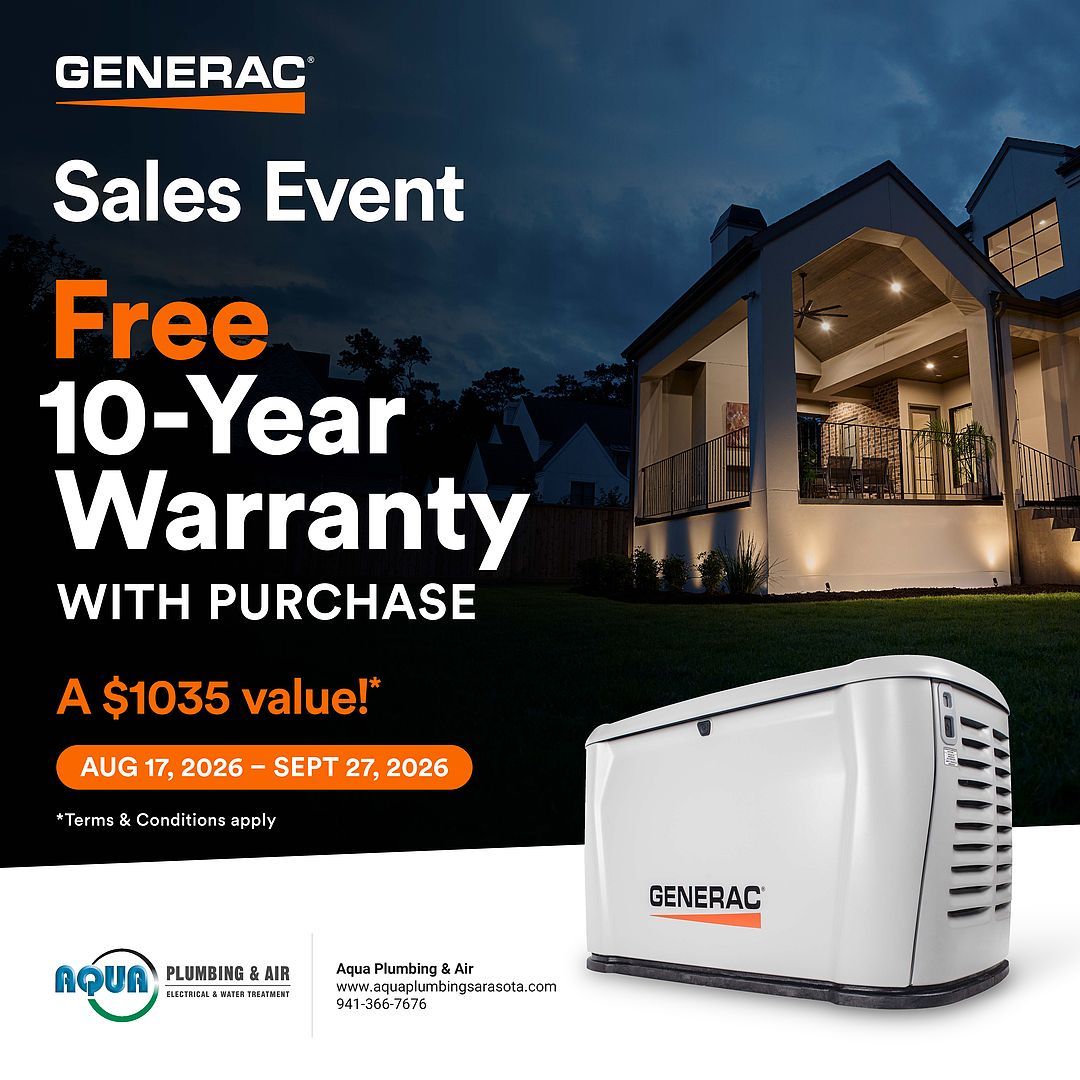
At Aqua Plumbing & Air, we've been serving Sarasota, Bradenton, and Lakewood Ranch since 1974. Our electricians are licensed, background-checked, and fully insured. We'll take care of everything — from load calculation to final installation — so your home is ready before the next storm season hits.
Ready to get started? Schedule your free generator assessment online or call us at 941-366-7676. We're available 24/7 for emergencies.
Learn more about our generator installation services →

CALL NOW OR REQUEST SERVICE ONLINE
Need fast, reliable service? Our friendly team is just a phone call away. Whether you prefer to speak directly with one of our experts or schedule your appointment online, we make it simple and convenient to get the help you need—anytime. Call us today for immediate assistance or request service online at your convenience, and let our trusted professionals take care of the rest.